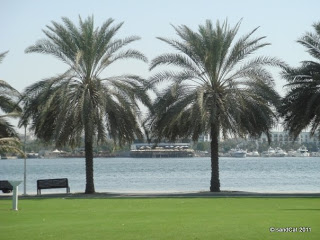
When you think of the desert you kinda imagine miles and miles of rolling sand dunes, and little else right? But the reality is a little different. Whilst it is dry and dusty there are still plants that manage to eke out an existence on what little moisture they catch from morning dew and days of high humidity. Of course in the oasises (oasi? what is the plural?) there is a lot more water, and thanks to a clever system of irrigation trenches, or falaj, more foliage is concentrated here. And most commonly of all you will find the date palm. In fact you will see these plants (trees?) all over the place here.

It’s not really surprising (that you see so many that is) as palms are a) incredibly resilient to the hot conditions (although they do need a constant and steady water supply) and b) they have a loooooong history with the Emirati people. Apparently the date palm outnumbers humans in the UAE by 5 to 1! Used for centuries for everything from food (obviously) to shelter (the fronds and trunks) the palms ensured a means of survival in a tough climate. Fisherman made small rowing boats or shoosh boats from the stripped fronds, held together by rope made from the palm fibres. Buoyancy was provided by the porous stalk. The fruit, or dates, is used in numerous dishes and fed to small children (mashed with nuts and water). It’s no wonder then that this symbol of the desert is found on the 10 dirham note (are you noticing a theme here?)*
Incidentally the annual Liwa Date Festival began yesterday in Abu Dhabi, well Al Gharbia to be precise, and runs until the 21 of the month (where-after it moves to Ajman). The event features 160 shops selling locally made wares, plus an exhibition of traditional tents and a cooking competition involving dates. So if you fancy learning more, pop on down.
My dad has a theory that men’s snoring is actually an evolutionary thing that arose from a need to scare away wild animals and other nefarious cave-men in the area (haha Darwin rolls in his grave I’m sure). In case that wasn’t enough for the Bedouin and Mountain tribes they took to carrying a traditional dagger, called a khanjar, to protect home and family (let’s face it those frond houses probably weren’t that secure). The dagger was worn by the men as a wardrobe essential, and an expression of their masculinity. However it was considered bad etiquette to reveal the blade (maybe it’s like a Samurai sword? If you revealed the blade you had to kill someone?) Anyway, these days it’s a rare sight to see a man actually wearing the dagger in public, as you would imagine modern security regulations have made it impractical to wear outside of your house. With some of these daggers now valued at 150,000 dirhams (40,000 USD) you probably would leave them at home too! Although the khanjar has now been relegated to a collector’s item, it remains a symbol of unity and independence for the men here, and is a prized possession. It’s only fitting then that this symbol joins the date palm on (the reverse of) the 10 dirham note.
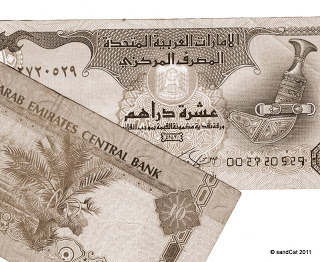
* Honestly I can’t take credit for this mini-tour through the history of the local currency (dirham), it’s a series being run in the paper, but I thought it was interesting enough to share. Agree?